
After filling in the form, we'll give you a whistle stop tour of our platform, showing you how easy Payroll Giving is to get set up.
 Payroll Giving Explained: Everything employers need to know >>

ESG Social Impact Explained
Alice Wright, GoodPAYE
ESG has become one of the most widely discussed frameworks in corporate responsibility. Investors, regulators and customers increasingly expect organisations to demonstrate strong performance across Environmental, Social and Governance factors.
Much of the conversation understandably focuses on environmental commitments such as reducing carbon emissions, improving energy efficiency or building more sustainable supply chains. These initiatives often receive the most attention.
However, the “S” in ESG – which stands for ‘Social’ – is just as important.
It examines the human side of business.
In this article, we’ll explore what ESG social impact really means, how it differs from sustainability, why it matters and what businesses can do to strengthen their own social impact strategy.
See how your organisation can reap the benefits of charitable giving
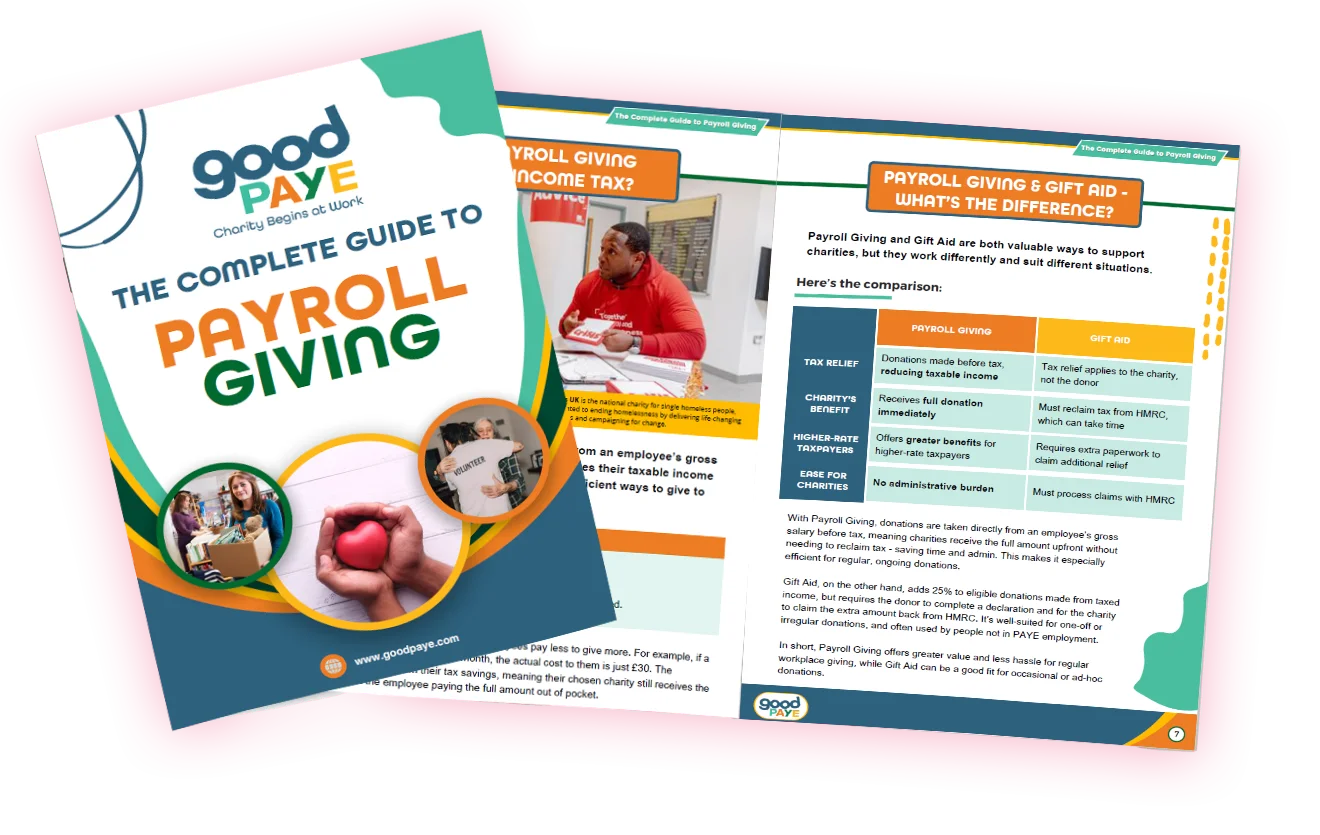
Download your free guide to Payroll Giving here
Everything employers need to know about running a payroll donation scheme.
Putting the “S” in ESG
ESG stands for Environmental, Social and Governance, and is a framework widely used by organisations to evaluate how responsibly a company operates.
The environmental pillar focuses on issues such as climate change, emissions and resource use. Governance looks at leadership, transparency and ethical decision-making. The social pillar, meanwhile, considers how a company interacts with the people connected to its operations.
In practical terms, the “S” in ESG often looks at whether organisations:
- Treat employees fairly and respectfully
- Protect human rights throughout their supply chains
- Promote diversity, equity and inclusion in the workplace
- Maintain safe and healthy working environments
- Contribute positively to local communities
- Protect customer data and respect privacy
When organisations perform well in these areas, they demonstrate that their activities create value not only for shareholders, but also for the people and communities that support their success.
So, social impact is fundamentally about how business decisions affect people.
ESG vs Sustainability vs Social Impact
These terms frequently appear together in corporate reports and sustainability strategies. Because of this, they’re sometimes used interchangeably.
But they actually refer to different concepts that operate at different levels.
Understanding how they relate to each other helps clarify how ESG works in practice.
1. Sustainability: the big-picture goal
Sustainability refers to operating in a way that protects the long-term health of the planet, society and the economy.
At its core, sustainability asks a straightforward question:
Can our current way of doing business continue without harming the resources and systems future generations depend on?
So, sustainability may involve reducing environmental impact, managing resources responsibly or building ethical supply chains.
In this sense, sustainability represents an overall objective to create a business model that is responsible, resilient and capable of operating successfully over the long term.
2. ESG: the measurement framework

While sustainability describes the goal, ESG provides the structure used to measure progress towards that goal.
ESG introduces a framework that organisations can use to assess and report their performance across three areas:
- Environmental: climate impact, emissions, energy use and resource management
- Social: treatment of employees, communities and customers
- Governance: leadership accountability, transparency and ethical decision-making
This structure allows stakeholders to evaluate how responsibly an organisation operates. It also enables companies to track improvements over time and identify areas where further progress is needed.
ESG turns sustainability into something that can be measured, compared and reported.
3. Social impact: the human outcomes
Social impact focuses specifically on the human outcomes of business activity.
It considers whether a company’s actions improve people’s lives, protect their rights and creates fair opportunities. This includes the treatment of employees, labour practices within supply chains, community support and initiatives that promote diversity and wellbeing.
While ESG provides the reporting framework, social impact reflects the real-world experience behind the data (the tangible effects business decisions have on individuals and communities).
How they connect
These ideas work together rather than competing with one another.
- Sustainability is the long-term vision.
- ESG is the framework used to measure progress.
- Social impact represents the real-world outcomes for people.
This is why the “S” is particularly powerful. It translates corporate responsibility into changes that employees, communities and society can experience day-to-day.

Social Impact Advances ESG Efforts
Strong social initiatives do more than demonstrate goodwill or fulfil reporting requirements.
When businesses invest in people they often reinforce other areas of ESG, such as responsible governance, ethical supply chains and sustainable growth.
For example, organisations that prioritise employee wellbeing and fair workplace practices frequently see higher engagement, improved productivity and lower staff turnover. Companies that actively support local communities tend to develop stronger trust and reputation, which can help attract customers, partners and talent.
Similarly, organisations that maintain strong labour standards throughout their supply chains are better positioned to avoid reputational risks and regulatory challenges. By ensuring suppliers operate ethically, businesses reduce the likelihood of issues such as labour exploitation or unsafe working conditions arising later.
In this way, social impact becomes a foundation for wider ESG progress.
Social impact initiatives that bolster ESG goals might come in the form of:
- Employee wellbeing programmes
Supporting both physical and mental wellbeing helps employees feel valued and supported. Organisations that prioritise wellbeing often benefit from improved engagement, stronger morale and a healthier workplace culture.
- Fair labour policies
Ensuring fair pay, safe working conditions and ethical treatment of workers, both within the organisation and across supply chains, helps reduce operational risk while reinforcing responsible business practices.
- Community investment
Supporting local communities through volunteering, charitable partnerships or social initiatives allows organisations to demonstrate meaningful contribution while strengthening relationships with the communities around them.
- Inclusive hiring practices
Promoting diversity, equity and inclusion expands access to opportunity while helping organisations build more innovative and balanced teams.
- Responsible data management
Protecting customer data and respecting privacy is increasingly recognised as an essential responsibility organisations have towards the people they serve.
Ultimately, social impact turns corporate responsibility into practical action.

Watch on demand:
Payroll Giving Webinar
In this short webinar, we cover:
The impact Payroll Giving has
How employers can make a difference
What you can do to drive social change
Why Social Impact Matters for Businesses
The social pillar of ESG plays an increasingly important role in assessment by regulators, investors and employees.
Businesses are expected to demonstrate responsible behaviour towards the people connected to their operations.
It’s an important consideration, driven by factors like:
1. Risk management
Poor labour standards or unsafe working conditions within a supply chain can quickly lead to reputational damage, legal consequences and disruption to ops.
Strong social governance identifies any potential risk early and nips it in the bud.
2. Talent attraction and retention
Companies that prioritise fair pay, inclusive cultures and employee wellbeing are often better at attracting and retaining talented people. Workplaces that genuinely support their employees tend to benefit from stronger engagement and loyalty.
3. Investor confidence
Businesses that demonstrate strong social policies coupled with measurable community impact are viewed as more responsible and resilient, which improves investor confidence.
4. Brand reputation
Customers are aware of how companies operate and the values they represent.
So brands that demonstrate genuine commitment to social responsibility (through fair employment practices, ethical supply chains and community support) often boost customer loyalty and referrals.
Social Impact + Workplace Giving
Workplace giving allows employees to support charities and causes they care about directly through their salary.
Donations are made before tax, allowing employees to give more to charity at a lower personal cost.
These programmes provide employers with a straightforward way to support charitable giving while contributing to wider social responsibility goals.
Social Impact Should Be a Business Priority
ESG is now a central part of how organisations demonstrate responsibility.
While environmental commitments often receive the most attention, the social pillar focuses on something equally important: people.
From fair employment practices and inclusive workplaces to community investment and responsible data management, the “S” in ESG reflects how organisations operate beyond profit alone.
After all, in business as in life, how you treat people tends to matter.