
After filling in the form, we'll give you a whistle stop tour of our platform, showing you how easy Payroll Giving is to get set up.

 Payroll Giving Explained: Everything employers need to know >>

Alice Wright, GoodPAYE
If you’ve ever sat in a meeting where someone asked, “So, what’s our social impact this year?” and the room fell into an awkward silence, you’re not alone. Measuring social impact has become one of those phrases that’s handed to HR with a shrug and a “you’ll sort it, won’t you?”
Well, the good news is it’s far less daunting than it first appears, provided you approach it with the right structure and data.
This guide walks through what social impact reporting involves, why it matters more than ever, and how to build a process that’s credible and drives consistent improvement. If you’re also working on the wider picture of employee benefits and wellbeing, this fits neatly alongside that work.
Download your free guide to Payroll Giving here
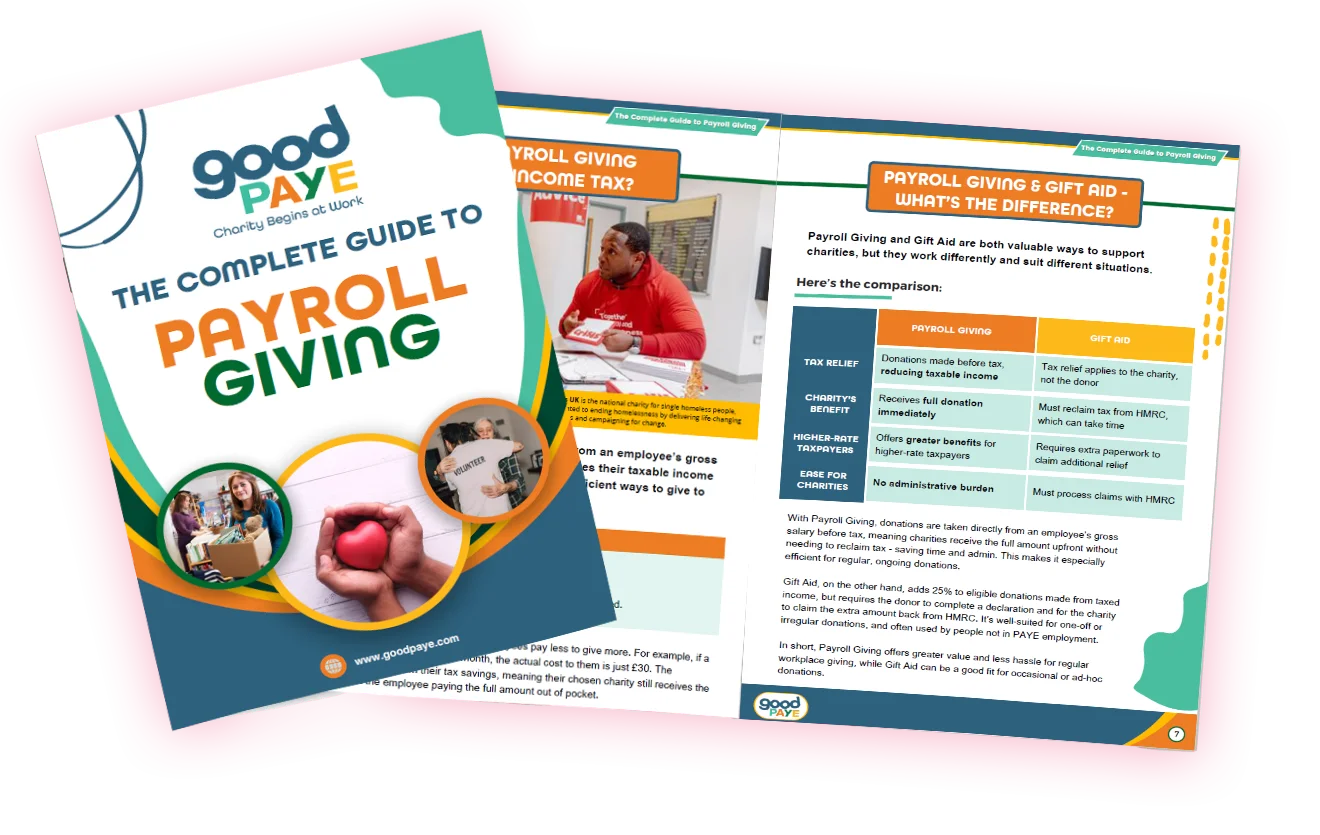
Everything employers need to know about running a payroll donation scheme.
Social impact refers to the effect your organisation has on people and communities, both inside and outside the business. That includes your workforce, your supply chain, the local community, and wider society.
For HR specifically, this often covers areas such as:
Social impact reporting, then, is the process of capturing, measuring, and communicating the above.
There’s a temptation to view social impact reporting as a compliance exercise: something you do because a regulator, investor, or client asks for it. And whilst there’s little doubt that pressure is real, there’s a more compelling reason to take it seriously…
People genuinely care.
Employees increasingly choose where to work based on an organisation’s values and behaviours, not just its salary bands. Candidates ask about social impact in interviews now, not just what the pension scheme looks like. Many of these expectations tie directly into how organisations think about reward and recognition, so it’s worth keeping the two conversations connected.
Getting this right helps with:
For a useful primer on how this fits within wider sustainability expectations, the CIPD’s guidance on sustainable business is a solid starting point.
Before diving into spreadsheets and surveys, take a step back. What does social impact mean for your business specifically?
A manufacturing company might focus heavily on workplace safety and local employment.
A professional services firm might prioritise volunteering hours and pro bono work.
A tech startup might centre its efforts on inclusive hiring and flexible working.
There’s no universal template, so sit down with leadership, sustainability pros (if you have anyone in that capacity) and key stakeholders to agree on the priority areas.
This becomes your framework, and everything else builds from here.

This is where many HR teams tend to either go too big or too small. Too big, and you’re drowning in data nobody can interpret. Too small, and your report reads like a single, slightly apologetic paragraph.
Aim for a handful of meaningful, measurable indicators across your priority areas. For example:
The key is reporting consistency. Choose metrics you can track reliably year after year, so you can show progress, or honestly, areas where progress hasn’t happened yet, which is just as important to monitor.
Most of the hard work in social impact reporting is data collection, not storytelling.
Before you can report anything meaningful, you need to know where your data lives. Is it in your HR information system? Scattered across spreadsheets that three different people maintain? Sitting in someone’s head because Dave’s been doing it that way for years?
Take time to audit your data sources, identify gaps, and put processes in place to capture information consistently going forward. This might mean updating your HRIS fields, adding questions to onboarding forms, or simply documenting Dave’s processes!
This is perhaps the most important point in this entire guide, so we’ll say it plainly: don’t be tempted to only report the good news.
Social impact reporting that reads like a highlight reel tends to raise eyebrows, particularly among employees who know what it’s actually like to work there. If your gender pay gap has widened, say so, and explain what you’re doing about it. If your employee engagement scores dipped, acknowledge it and set out your plan to tackle this.
Transparency builds credibility, whereas PR-spin erodes it. And in an age where employees can, and do, share their experiences publicly online, the gap between your reported values and lived reality tends to close fairly quickly, whether you like it or not. The UK government’s own gender pay gap reporting service is a good reminder of how publicly available some of this data already is.

In this short webinar, we cover:
The impact Payroll Giving has
How employers can make a difference
What you can do to drive social change
Once you’ve gathered your data, resist the urge to present it as a wall of tables. Nobody, not your board, not your employees, not your investors, wants to wade through dense spreadsheets to understand whether your social impact strategy is working.
Use a clear narrative alongside your data. Explain what the numbers mean, why they matter, and what you’re doing in response. Visual summaries, simple charts, and short case studies can bring the report to life without compromising on rigour.
Think of it less as a compliance document and more as a story about your organisation’s relationship with its people and communities. Admittedly it needs to be a story backed by evidence, but a story nonetheless.
If your organisation is required to report against frameworks such as the UN Sustainable Development Goals, the Global Reporting Initiative (GRI) Standards, or wider ESG reporting requirements, make sure your social impact metrics map across sensibly.
This doesn’t mean reinventing your entire approach to fit external frameworks, but it does mean being aware of how your internal reporting aligns with broader expectations. It saves duplication of effort and makes your reporting more credible to external stakeholders who recognise these standards.
Social impact reporting isn’t a once a year fire drill, even though it can sometimes feel that way. The most effective approach treats it as an ongoing process, with regular check-ins on progress, adjustments to targets, and continuous improvement to data quality.
Build in time, perhaps quarterly, to review how things are tracking against your goals. This makes the annual reporting process far less stressful, and far less likely to involve last minute panic.
Workplace giving allows employees to support charities and causes they care about directly through their salary.
Donations are made before tax, allowing employees to give more to charity at a lower personal cost.
These programmes provide employers with a straightforward way to support charitable giving while contributing to wider social responsibility goals.
Measuring social impact and producing meaningful social impact reporting shouldn’t be a box-ticking exercise. Nor should it involve producing the most impressive looking document in the industry. Instead, it should centre on understanding the real effect your organisation has on the people connected to it, being honest about where things stand, and using that understanding to do better.
For HR professionals, this is genuinely an opportunity, as you’re often closest to the data and the stories that matter most: how people are treated, supported, and developed. Done well, social impact reporting doesn’t just satisfy external requirements, it becomes a useful tool for shaping a better workplace.