After filling in the form, we'll give you a whistle stop tour of our platform, showing you how easy Payroll Giving is to get set up.

 Payroll Giving Explained: Everything employers need to know >>

Payroll giving is one of the most tax efficient ways for employees in the UK to donate to charity, yet it remains one of the most underused workplace benefits going. If you’ve ever wondered what payroll giving actually is, how a payroll giving scheme works, or whether it’s better than Gift Aid, this guide covers everything you need to know.
Skip to:
Everything employers need to know about running a payroll donation scheme.
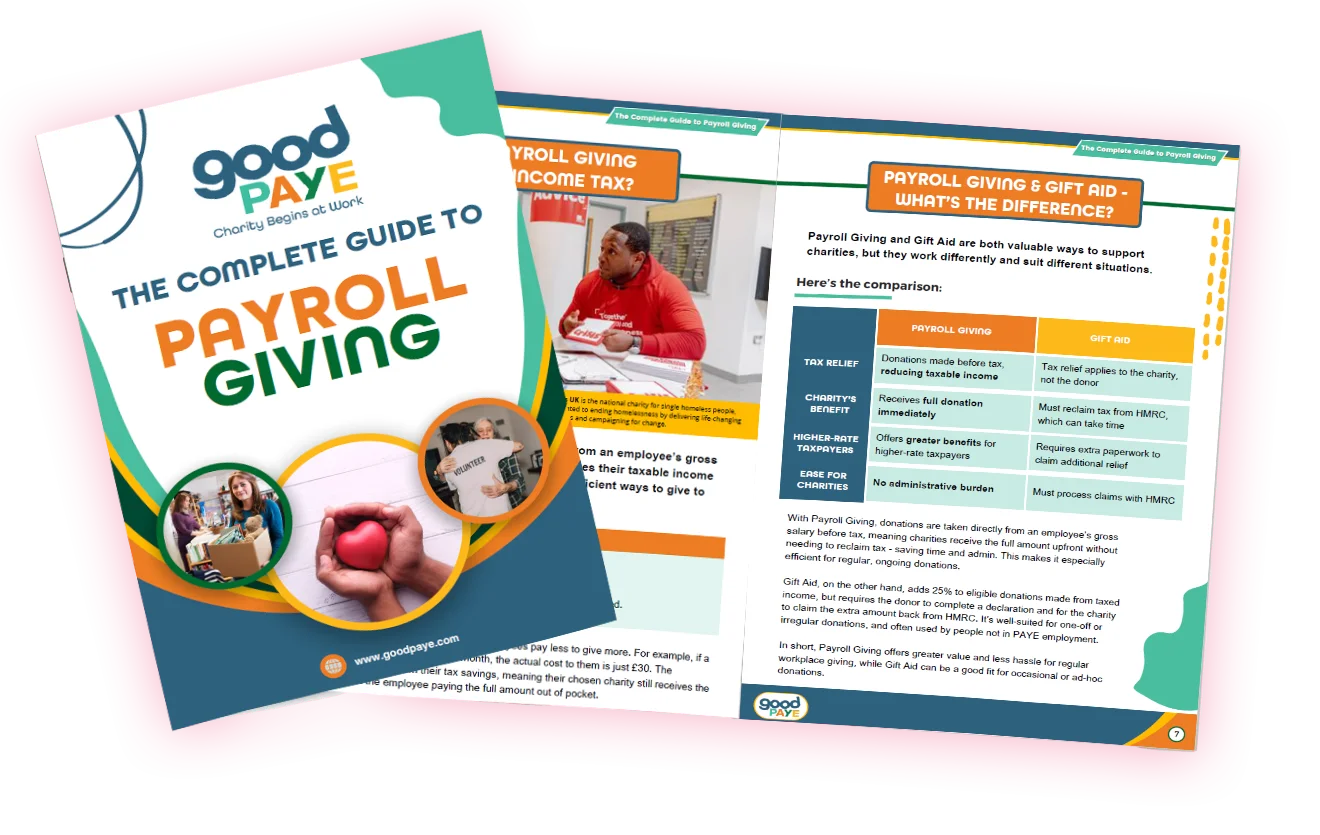
Payroll giving is a UK government approved scheme that lets employees donate to charity directly from their gross salary, before income tax is deducted. Because the donation comes out before tax is calculated, both the employee and the charity benefit more than they would from a standard donation made from take home pay.
It’s sometimes referred to as Give As You Earn (GAYE), particularly when operated through the Charities Aid Foundation, or simply Workplace Giving. Whatever name it goes by, the mechanics are the same: your employer deducts your chosen donation from your salary before passing it to a HMRC approved Payroll Giving Agency (PGA), which then distributes the funds to your chosen charities.
For employees, it means their generosity costs them less. For charities, it means receiving the full donation without the administrative burden of reclaiming tax through Gift Aid. And for employers, it’s a meaningful, low effort way to demonstrate real commitment to corporate social responsibility.
Businesses with active Payroll Giving schemes can even apply for the Payroll Giving Quality Mark. This certification highlights their dedication to philanthropy and can be used as a promotional tool to attract talent who value corporate responsibility.
Setting up and using a payroll giving scheme is more straightforward than most people expect. Here’s the basic process:
To further streamline the process, organisations like GoodPAYE also provide digital platforms where employees can track their donations and make changes to their charitable preferences at any time. Making it a breeze for employers to administer.
Absolutely. Payroll Giving reduces an employee’s taxable income because donations are deducted before tax.
This means that:
These tax savings make Payroll Giving a cost-effective way to contribute to charity while lowering personal tax bills.
Check out our Payroll Giving Tax Calculator to see exactly how much your employees can save.
For example, if an employee donates £50 a month through Payroll Giving and they are a higher-rate taxpayer, the cost to them is just £30.
The remaining £20 comes from their tax savings, meaning their generosity has an even greater impact without additional personal expense.

Since the donations are taken from gross pay, there are no deductions or administrative fees on the charity’s end. However, there are admin fees involved with Payroll Giving, which are automatically applied to the employee’s donation. These fees are minimal. Employers have the opportunity to cover these costs to ensure all donations go to charity.
This is a significant advantage over Gift Aid, where charities must apply to HMRC to reclaim tax on donations – which can take time and add to administrative costs. Additionally, Payroll Giving provides charities with a predictable stream of income, as regular donations help them plan and allocate resources effectively.
Payroll Giving also supports charities large and small.
This helps smaller charities – which may lack the resources to administer tax reclamations through Gift Aid – to raise much needed funds. It’s fully inclusive, with every UK charity free to benefit. Which allows employees to support niche causes or grassroots organisations that align with their personal values.
Yes, and this is one of the key reasons it’s worth taking seriously. Because donations are made from gross pay, they reduce the employee’s taxable income, meaning the cost of giving is lower than it appears.
Here’s how the tax saving breaks down depending on your tax band:
| Monthly Donation | Cost to 20% Taxpayer | Cost to 40% Taxpayer | Cost to 45% Taxpayer | Charity Receives |
| £10 | £8 | £6 | £5.50 | £10 |
| £25 | £20 | £15 | £13.75 | £25 |
| £50 | £40 | £30 | £27.50 | £50 |
A higher rate taxpayer donating £50 a month is, in practice, contributing just £30 of their own money. The remaining £20 comes from what would otherwise have gone to HMRC as tax. The charity, meanwhile, receives the full £50.
It’s worth stressing that payroll giving is particularly advantageous for higher and additional rate taxpayers. Unlike Gift Aid, where higher rate relief has to be claimed separately via a self assessment tax return, payroll giving delivers the full tax benefit automatically.

Payroll Giving and Gift Aid are both beneficial but serve different purposes.
Here’s a comparison:
| Feature | Payroll Giving | Gift Aid |
| Tax Relief | Donations made before tax, reducing taxable income | Tax relief applies to the charity, not the donor |
| Charity’s Benefit | Receives full donation immediately | Must reclaim tax from HMRC, which can take time |
| Higher-rate Taxpayers | Offers greater benefits for higher-rate taxpayers | Requires extra paperwork to claim additional relief |
| Ease for Charities | No administrative burden | Must process claims with HMRC |
So Payroll Giving often provides better value. With charities benefiting from receiving funds instantly without additional administrative steps.
Gift Aid, however, can be advantageous for one-off or irregular donations, and for those that are not in full-time employment.
Both systems are valuable tools for supporting charitable causes and which you choose depends on individual preferences and circumstances.
One of the great features of Payroll Giving is its flexibility, as employees can donate to any UK-registered charity.
This includes:
Some employers also allow employees to support non-charitable organisations, such as sports clubs or cultural groups, provided they meet the scheme’s eligibility criteria. This broad scope ensures that every employee can find a cause that they hold dear. At GoodPAYE, we partner with over 200 charities, which are readily available to select on our platform. However, employees can support any UK charity of their choice. If their preferred charity isn’t on our list of 200, they can simply type it into their application, and we’ll take care of the rest by contacting the charity and setting it up on their behalf.
Setting up a Payroll Giving scheme is simpler than most assume. Here’s a practical overview:
Employers need to choose an HMRC-approved PGA to manage the scheme. These agencies handle the distribution of donations to charities, ensuring compliance and eliminating the admin burden for Payroll/Finance teams.
(Working with GoodPAYE for your Payroll Giving scheme means we’ve got this bit covered for you, so no need to browse through the HMRC website!)
Communicate the benefits of Payroll Giving to employees. Highlight the tax savings, the flexibility to choose charities and the simplicity of the process. Use internal newsletters, posters or team meetings to raise awareness.
Work with your payroll department to set up pre-tax deductions. Any modern payroll systems can accommodate these adjustments easily.
(With GoodPAYE, a single export from your Payroll System and just one bank transfer is all you need to administer. Here’s how it works).
(Team up with GoodPAYE and we’ll provide you with monthly comms, webinars and in-person visits to boost uptake).
Make signing up as easy as possible. Consider whether your business might match donations, even partially, as this can significantly increase employee engagement. Regularly sharing the collective impact of your scheme (total donated, charities supported) keeps enthusiasm alive and reinforces a culture of giving.
Regularly review the scheme’s uptake and address any employee queries along the way.
Be sure to playback the total donated and the impact that’s had on chosen charities to maximise employee enthusiasm for the scheme.
Employers can also track participation rates and celebrate milestones, such as total donations reaching a specific amount. This fosters a sense of collective achievement and motivates ongoing participation.
Beyond the obvious benefit to charities, payroll giving schemes make good business sense.
Employees increasingly want to work for organisations that share their values. Offering a structured, tax efficient way to give back, and potentially matching donations, signals that your business takes corporate responsibility seriously. It is not just a feel good policy; it feeds directly into employee engagement, retention, and the kind of reputation that attracts the right people.
Businesses with active schemes also report a stronger sense of shared purpose within their teams. When employees can see the collective impact of their giving; the total donated, the charities supported; it builds something genuinely meaningful in the workplace.
Payroll giving doesn’t ask much of anyone. Employees give a little, keep more than they expect, and charities receive everything. Employers run the scheme with minimal administrative overhead and gain a benefit that matters to their workforce.
If your organisation doesn’t yet offer a payroll giving scheme, the question worth asking isn’t why would we? and it is simply: why haven’t we yet??*
GoodPAYE makes it simple to get started. Sign up for free or get in touch to find out how we can help your business give as you earn.
Everything employers need to know about running a payroll donation scheme.