After filling in the form, we'll give you a whistle stop tour of our platform, showing you how easy Payroll Giving is to get set up.

 Payroll Giving Explained: Everything employers need to know >>

Alice Wright, GoodPAYE
Tax-free employee benefits are a smart, cost-effective way to boost satisfaction with overall compensation in your workplace. These staff perks add value to your employees’ salary, without either of you taking a hit on tax or National Insurance.
Which is a very efficient use of your employee benefits budget!
From salary sacrifice schemes to charitable giving, the UK offers a surprising number of tax-efficient options that can support financial wellbeing and strengthen your company culture.
And the best part is many of them cost very little to implement… or nothing at all.
Whether you’re an HR manager reviewing your current benefits package, a finance lead looking to reduce overheads, or a business owner wanting to give back to your team, this guide covers the key tax-free perks available in the UK right now.
In this article, we cover:
This scheme enables employees to donate to UK-registered charities directly from their gross salary, before income tax is deducted.
This means they can give more to the causes they care about, while it costs them less.
For example, a £10 donation only costs a basic-rate taxpayer £8. The charity still receives the full £10, and there’s no need to claim Gift Aid or fill out any forms. It all happens automatically through payroll.
For employees, it’s a simple, tax-efficient way to support the charities they love – whether that’s Cancer Research UK, a local food bank, or an animal shelter – any UK registered charity qualifies.
And because it comes out of their pay automatically each month, they don’t have to think about it or budget for a lump sum later in the year.
For employers, Payroll Giving is a completely free benefit to offer, which speaks volumes about your values. Supporting Payroll Giving shows that you’re committed to social impact and employee wellbeing. And unlike many other perks, it’s completely inclusive. Everyone can get involved, no matter their salary, department or location.
To boost engagement, some employers even match donations – doubling the impact for the charity and creating a sense of shared purpose within the team. Others run charity awareness campaigns or host drop-in sessions to help employees discover causes that resonate with them.
If you work with our B Corp-certified Payroll Giving team here at GoodPAYE, you’ll also get access to tailored onboarding, branded giving platforms, employee dashboards, and even in-person launch events to make the whole experience more engaging.
A few more reasons to consider it:
1. There’s no tax liability for the employer or employee.
2. It’s recognised in the Government’s CSR frameworks and B Corp impact assessments.
3. It helps create a stronger emotional connection between employees and your brand.
4. It’s one of the few tax-free benefits that also supports your ESG and sustainability goals.

In this short webinar, we cover:
The impact Payroll Giving has
How employers can make a difference
What you can do to drive social change
A solid pension scheme is one of the most valued employee benefits in the UK – and it’s also one of the most tax-efficient.
When employers make contributions into a workplace pension scheme, those payments are not treated as a benefit in kind. That means no income tax or National Insurance contributions (NICs) are due from the employee, and the employer doesn’t pay NICs either. So, it’s a highly effective way to support your team’s future while making smart use of your payroll budget.
For example, if you contribute 5% of an employee’s salary into their pension pot, that full amount goes in tax-free. It doesn’t cost the employee anything, and it shows that you’re invested in their long-term financial wellbeing.
But this benefit gets even better when you introduce salary sacrifice…
With salary sacrifice, the employee agrees to give up part of their gross salary, and you, as the employer, pay that amount directly into their pension instead. Because the “sacrificed” salary isn’t subject to income tax or NICs, both parties save money.
Let’s say your employee earns £35,000 a year and wants to contribute £200 a month to their pension. Instead of taking it from their net pay, they agree to reduce their gross salary by £200 per month, and you pay that directly into the pension scheme. The result? They save on both income tax and National Insurance, and so do you. The pension pot gets the full £200, but it costs the employee significantly less in take-home pay.
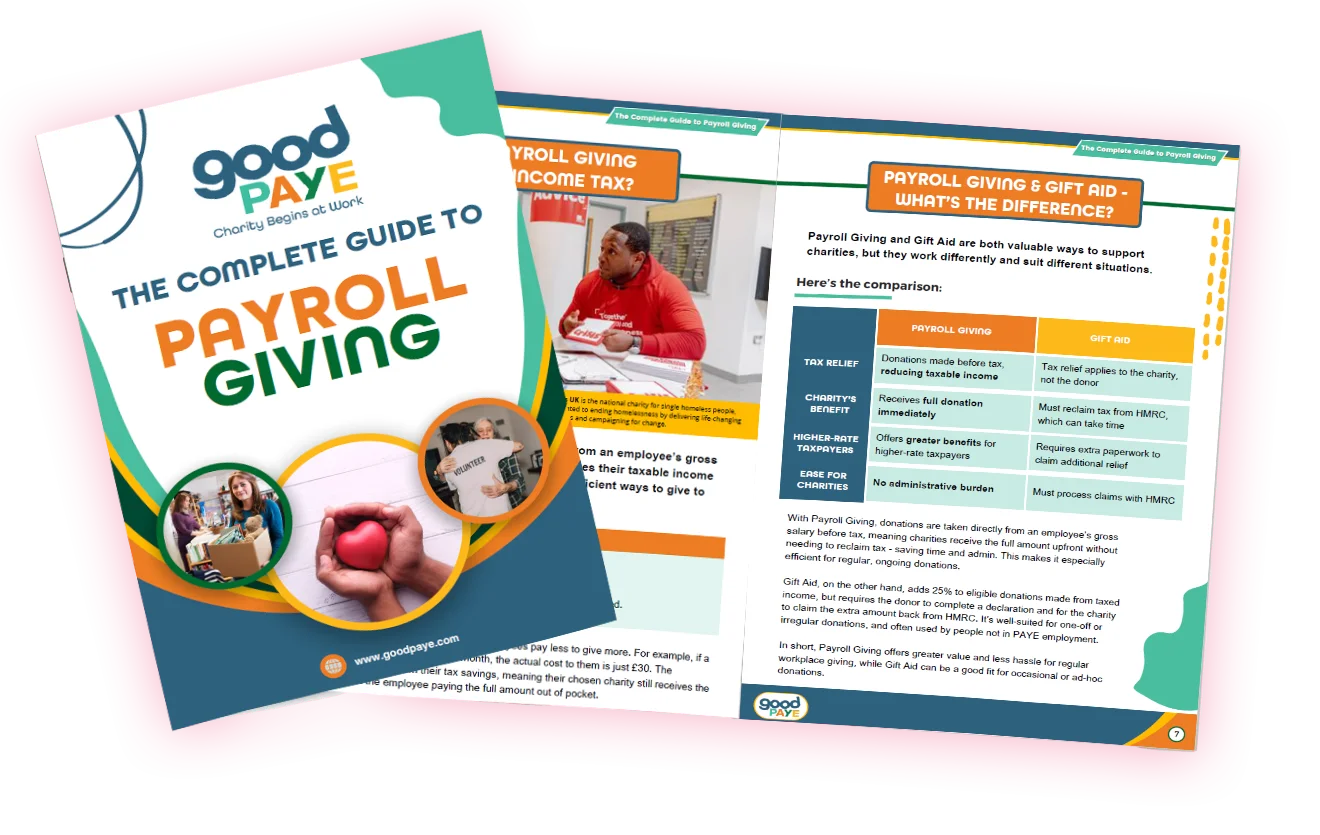
Everything employers need to know about running a payroll donation scheme.
With salary sacrifice, the employee agrees to give up part of their gross salary, and you, as the employer, pay that amount directly into their pension instead. Because the “sacrificed” salary isn’t subject to income tax or NICs, both parties save money.
Many organisations now offer enhanced employer contributions through salary sacrifice schemes.
For instance :
Why it Matters
A good pension isn’t just a tick-box benefit, it’s a key part of an employee’s financial security. And with rising living costs and uncertainty around the state pension, private pension contributions are more important than ever.
By using a tax-free method to support retirement saving, you:
1. Help employees build a stronger financial future.
2. Reduce National Insurance costs for your business.
3. Strengthen your position as a responsible, caring employer.
For employees, it’s an expected benefit where the savings are tangible and immediate – especially when combined with a little additional employer generosity and clear communication about how it all works.

The Cycle to Work Scheme is a fantastic win-win: it helps employees save money, promotes greener commuting, and supports healthier lifestyles… all while reducing your payroll costs.
Under this government-backed initiative, employees can hire a bike and cycling accessories through a salary sacrifice arrangement. This means they agree to give up a portion of their gross salary in exchange for the use of the bike, spreading the cost over 12 to 18 months. Because the payments come out of their pre-tax earnings, employees save on both income tax and National Insurance.
At the end of the hire period, they usually have the option to purchase the bike for a nominal fee – typically 3–7% of its original value -making it an affordable and tax-efficient way to own a new bike.
Let’s say an employee chooses a bike and accessories worth £1,000. Instead of paying the full amount upfront, they pay it off monthly through their salary. If they’re a basic-rate taxpayer, their actual cost could be around £680, once tax and NI savings are factored in.
From the employer’s perspective, this arrangement reduces your National Insurance bill, as you’re paying slightly less in gross salary. For every employee who signs up, you save roughly 13.8% on the salary they’ve sacrificed.
The scheme covers a wide range of items, including:
Modern cycle schemes have become far more flexible. There’s no longer a strict £1,000 cap, meaning employees can now choose higher-end commuting gear.
It can be used for commuting or mixed travel, and there’s no requirement for the bike to be used every day – just “mainly for work purposes.”
Why It’s Worth Offering
The Cycle to Work scheme is more than just a nice perk:
1. It supports sustainable travel goals and helps reduce your organisation’s carbon footprint.
2. It encourages active commuting, which can reduce absenteeism and improve employee wellbeing.
3. It’s a low-cost benefit to offer that delivers real value to staff.
In short, it ticks the boxes for HR, finance, and ESG teams alike.

Providing employees with a mobile phone for work (and personal use) might sound like a luxury, but it’s actually one of the most straightforward tax-free employee benefits you can offer.
And with hybrid working now the norm, it’s also more relevant than ever.
As long as the contract is between the employer and the mobile provider, and the phone is issued primarily for business use, it’s completely exempt from income tax and National Insurance contributions – even if the employee also uses it for personal calls, texts, or data.
This makes it a simple, high-value perk with minimal admin.
Imagine your business provides an employee with a smartphone and a monthly plan costing £30. Because the contract is in your company’s name, and you’re paying the provider directly, there’s no taxable benefit for the employee, even if they stream music on the commute or use WhatsApp to chat with friends.
From your perspective as an employer, the phone is also a legitimate business expense, which can be offset against your profits when calculating Corporation Tax.
Why It’s Worth Doing
Offering a mobile phone as a tax-free benefit is a great way to:
1. Support remote and hybrid working
2. Standardise company communications
3. Avoid the complications of reimbursing expenses or calculating personal use
In many industries, a business mobile is now as essential as a laptop. And when done properly, it’s a cost-effective, tax-smart benefit that delivers real value.
Sometimes, it’s the little things that make the biggest difference.
Trivial benefits are a fantastic way to boost morale, celebrate personal milestones, or simply say “thank you” (without triggering any tax or National Insurance for either the employer or the employee).
As the name suggests, these are small perks, capped at £50 per benefit, that you can give to staff completely tax-free – provided they meet a few simple criteria.
To qualify as a trivial benefit, it must:
As long as all four conditions are met, there’s no need to report it to HMRC, and it won’t count towards the employee’s taxable income.
Here are a few popular ways companies use the trivial benefits rule:
As long as the item costs no more than £50 and isn’t linked to work performance, it’s usually safe to assume it qualifies.
Note: If you’re the director of a ‘close company’ (typically a limited company run by five or fewer shareholders), you can still receive trivial benefits – but there’s an annual cap of £300 per tax year. This means you can enjoy up to six small perks worth £50 each without creating a tax liability.
Why It’s Worth Offering
Trivial benefits are a cost-effective way to create goodwill and show appreciation.
They’re especially useful for:
1. Building a positive company culture
2. Celebrating personal milestones
3. Creating feel-good moments throughout the year
They might be called “trivial,” but when used thoughtfully, these perks can go a long way in boosting employee engagement, and all without any payroll headaches.
Yes, you really can throw a party on the company’s tab, tax-free.
Whether it’s the annual Christmas do, a summer BBQ, or a team day out, HMRC allows businesses to spend up to £150 per person, per tax year on staff entertainment, without it counting as a taxable benefit – again, as long as a few conditions are met.
To qualify for the exemption, your staff social event must:
As long as these criteria are met, the benefit is not taxable, so there’s no need to report it to HMRC, and employees won’t pay income tax or National Insurance on the value.
The total cost per person must cover everything – venue hire, food and drink, entertainment, transport, and even overnight stays if applicable.
It also applies per guest, so if partners are invited, the budget covers both attendees (e.g., £300 for an employee + guest).
It’s important to note: the £150 is an annual limit, not per event. So if you run multiple events in a year (say, a summer party and a Christmas party), the combined total per person must stay within that limit. If the cost exceeds £150 (even by £1) the entire amount becomes taxable, not just the overspend.
Why It’s Worth Doing
Offering tax-free social events helps:
1. Strengthen team morale and company culture
2. Show appreciation in a meaningful, memorable way
3. Attract and retain talent by offering experiences, not just salary
4. Celebrate achievements and bring teams together across locations
Especially in a hybrid-working world, getting people together in person now and again can make a big difference to engagement, and knowing you can do it tax-free is a bonus.

If your employees regularly use computers, laptops, or screens as part of their job, you’re legally required to consider the impact on their eyesight.
The good news is you can cover the cost of eye tests and contribute towards glasses specifically needed for screen use, tax-free.
Under Display Screen Equipment (DSE) regulations, employers must provide an eye test on request to employees who use screens daily. And if that test reveals that an employee needs glasses solely for DSE work, you’re allowed to fund a basic pair of glasses without it being treated as a taxable benefit.
This is more than ticking a compliance box – it’s a smart way to support employee wellbeing, avoid eye strain-related absences, and reinforce your commitment to health and safety.
With that in mind, there’s also…
Preventative care is gaining traction in workplace wellbeing programmes and thankfully, you can offer one health screening and one medical check-up per year, tax-free, per employee.
The exemption applies only if the employer arranges and pays for it directly (e.g., through a clinic or healthcare provider).
It’s designed to encourage early detection of health issues, reduce absenteeism, and promote a culture of care.
What doesn’t qualify?
Extras like dental treatments, physiotherapy, or follow-up consultations aren’t exempt unless you’re offering a more comprehensive (and typically taxable) private healthcare package.

Recognising loyalty doesn’t have to come with a tax bill.
If you’ve got employees who’ve been with you for 20 years or more, you can reward them with a non-cash gift – worth up to £50 for each year of service – completely tax-free.
That means someone celebrating 25 years could receive a gift worth up to £1,250, with no income tax or National Insurance implications, as long as the following conditions are met:
Long-service awards are a fantastic way to honour dedication, improve retention, and create proud moments, without incurring any tax liability, as long as you follow the rules.
There’s no one-size-fits-all approach to tax and employee perks, but with this toolkit, you’ve got plenty of low-cost, high-impact options at your fingertips.
Offering tax-free employee benefits not only helps your team feel valued, but also shows you’re a thoughtful, forward-thinking employer. From boosting take-home pay to supporting wellbeing and sustainability, these perks make a real difference, without costing the earth. Whether you’re refreshing your benefits package or building one from scratch, these tax-friendly options are a smart place to start.
While you’re here, if you want help setting up Payroll Giving for free in your workplace, register for our webinar now and we’ll show you how.