
After filling in the form, we'll give you a whistle stop tour of our platform, showing you how easy Payroll Giving is to get set up.

 Payroll Giving Explained: Everything employers need to know >>

Alice Wright, GoodPAYE
Most employees aren’t unwilling to give to charity from a workplace scheme. They simply aren’t being given the right opportunity.
That’s the uncomfortable truth behind a lot of underperforming workplace charity schemes. Employers set them up with the best intentions, mention them once, and then wonder why hardly anyone signs up. The instinct is to assume people just aren’t interested, but in our experience, that’s rarely the case.
When employee engagement with charitable giving is low, it’s usually because the scheme is invisible, effortful, occasional, or vaguely uncomfortable to get involved with. Fix those things, and you’ll find the appetite was there all along.
Here’s where workplace giving tends to go wrong – and how to put it right.
Download your free guide to Payroll Giving here
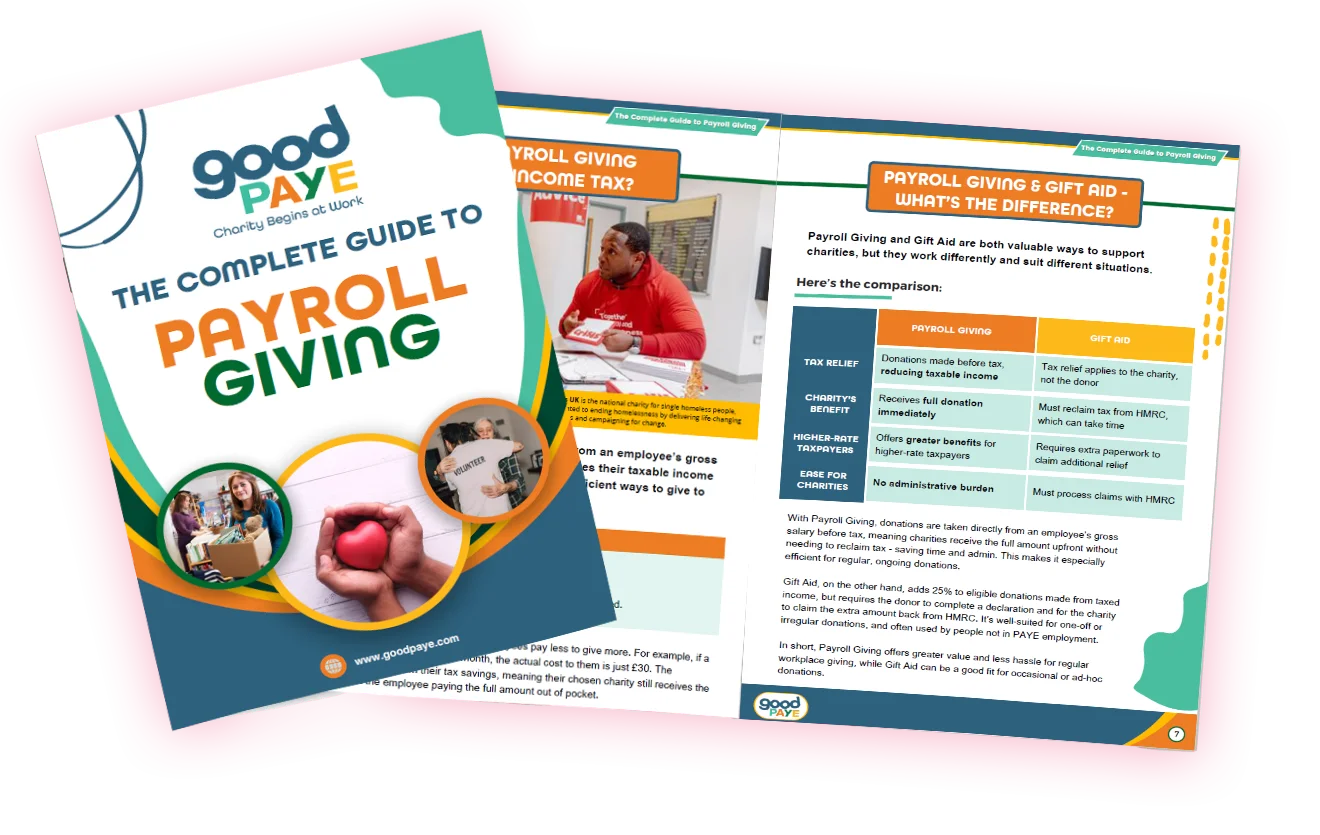
Everything employers need to know about running a payroll donation scheme.
You can’t engage employees with a benefit they don’t know exists.
It sounds obvious, but it’s the single biggest reason workplace giving schemes fall flat. Research from the Charities Aid Foundation, found that 59% of UK employees remain unaware of Payroll Giving.
That’s the majority of the workforce still blissfully unaware, at a time when Payroll Giving has been around since 1987 and is offered by thousands of employers.
Awareness isn’t a one-off job, either. People join, people leave, people forget. So, a benefit that might have been announced through a handout two years ago is, to a large chunk of your current team, a benefit that was never announced at all.
Think about how charitable giving usually shows up at work:
These are all good things. But they share a pattern: they’re moments.
They come around, they generate a burst of energy, and then everything goes quiet until the next one.
Meanwhile, the one scheme that could turn charitable giving at work into an everyday behaviour – Payroll Giving – sits in the background gathering dust, mentioned nowhere beyond a cursory bullet point in the onboarding pack.
If your employees only ever encounter charity as an occasion, they’ll treat it like one. Engagement spikes and then fades, because nothing about the experience suggests giving is something you do on a random Tuesday in March for no particular reason.

Even when someone wants to give, the process can stand in the way.
Finding a charity. Setting up a donation. Digging out bank details. Remembering to update a standing order when circumstances change. None of these are hard on their own, but together they add up to friction and friction is where good intentions go to die.
Your employees are already managing full workloads and busy lives. If supporting a cause feels like a mini admin project, most people will put it on the “I’ll do that later” list (and “later” has a nasty habit of never arriving).
The employers who see superb uptake are the ones who’ve stripped the effort out. Giving should take a couple of minutes, not an entire lunch break.

If people don’t know where their money goes, giving can feel abstract. And abstract things are easy to stop.
This is where a lot of employee giving schemes lose momentum. Someone signs up, the deduction appears on their payslip, and then… nothing.
No update.
No thank you.
No sense of what changed because of them.
Compare that with the experience of sponsoring a colleague’s half marathon: you see the training photos, the finish line, the total raised etc… It feels real.
Regular giving can feel just as real, but only if you close the loop. So show the connection between employee, donation, charity and impact. Share what your team has raised collectively. Let charities say thank you and celebrate milestones (a Payroll Giving Quality Mark Award is a good excuse to). When people can see the difference they’re making, they’ll keep making it.
There’s a fine line between encouraging generosity and pressuring people into it, and employees can feel it instantly.
Nobody wants to be the one who didn’t sign up in front of their manager. Nobody wants a “gentle reminder” that reads like a target. The moment giving feels like a corporate expectation, it stops being generous and starts being plain awkward, and the people who might have given willingly disengage.
A genuine culture of generosity means enabling, not coercing. Make giving accessible, visible and easy. Then trust your people to decide. Those who give will do so because they want to, which is the only kind of giving that lasts.

In this short webinar, we cover:
The impact Payroll Giving has
How employers can make a difference
What you can do to drive social change
If you’re wondering how to encourage employees to give to charity without any of the pitfalls above, the answer is less about persuasion and more about removing obstacles.
Here are some top tips:
Workplace giving allows employees to support charities and causes they care about directly through their salary.
Donations are made before tax, allowing employees to give more to charity at a lower personal cost.
These programmes provide employers with a straightforward way to support charitable giving while contributing to wider social responsibility goals.
The employers who get workplace giving right have stopped thinking of it as a benefit that sits in a handbook, and started thinking of it as a habit their people can build.
That’s what Payroll Giving does well. It takes the good intention someone has today and turns it into a regular, tax-efficient donation that happens automatically every payday – no bank details to remember, no standing orders to manage, no effort beyond the first couple of minutes. Employees choose their cause, see what they’ve given, and can change it whenever they like. Charities get reliable income they can plan around. And because it’s woven into the ordinary rhythm of getting paid, giving stops being an event and becomes part of working life.
Most of your employees would give if it were easy, personal and clearly worthwhile. Make it so, and you’ll be surprised how many of them already wanted to.
Charity begins at work. Your job is simply to open the door.