After filling in the form, we'll give you a whistle stop tour of our platform, showing you how easy Payroll Giving is to get set up.

 Payroll Giving Explained: Everything employers need to know >>

Alice Wright, GoodPAYE
Charity partnerships are a smart, strategic way for businesses and charities to work together for mutual benefit.
Executed well, a charity partnership can boost brand trust, motivate employees, raise vital funds and create real social impact. But when poorly executed… well, let’s just say a logo on a leaflet won’t change the world!
In this article, we’ll explore what makes charity corporate partnerships successful, the different models you’ll come across and a few charity partnership examples you can take inspiration from.
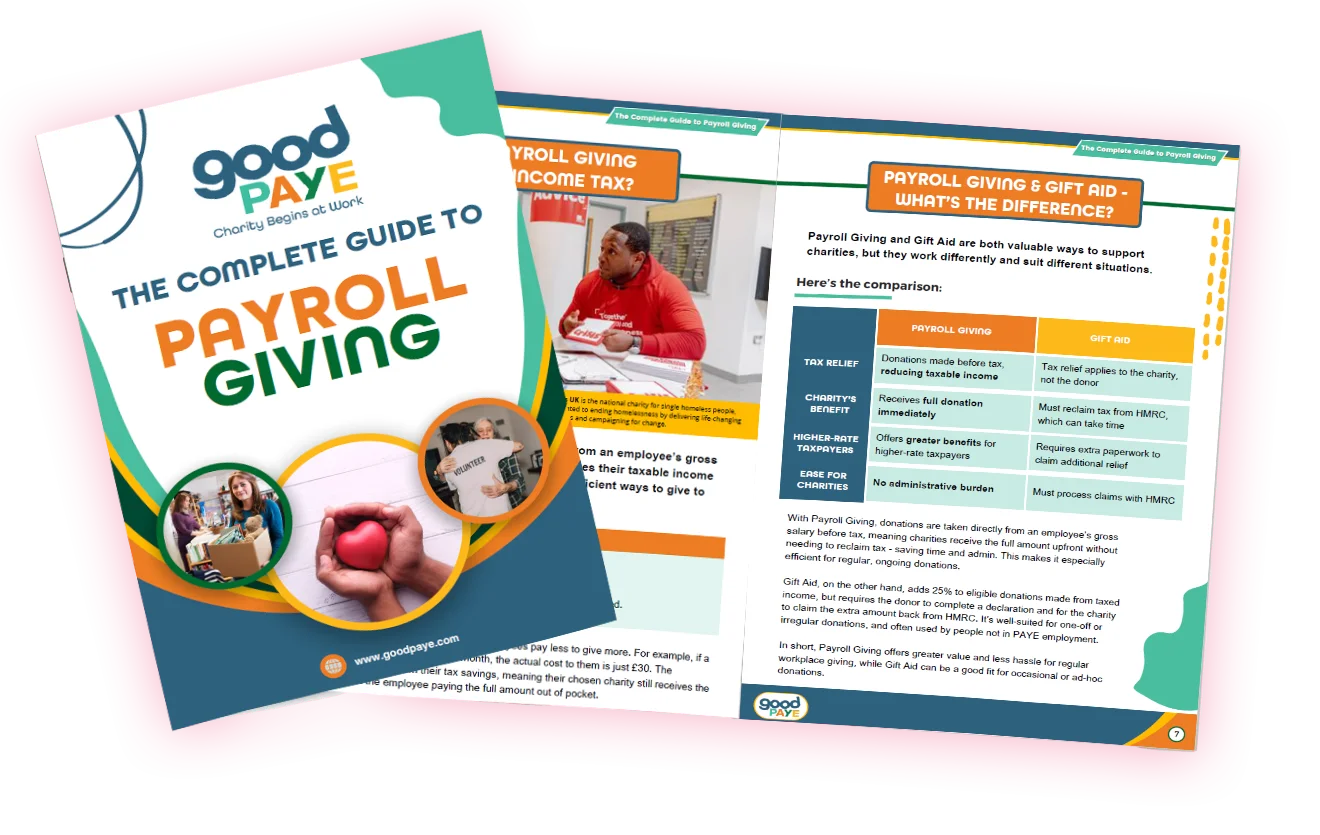
Download your free guide to Payroll Giving here
Everything employers need to know about running a payroll donation scheme.
A corporate charity partnership is a planned, ongoing relationship between a business and a charity, built around shared goals and long-term impact. It goes beyond a simple donation.
Instead, it focuses on an ongoing commitment to generate more meaningful long-term outcomes.
In a strong partnership, both sides actively contribute. Businesses may offer funding, pr platforms or people power. Whilst charities bring purpose, expertise and access to causes that matter. The result is tangible impact for communities, alongside clear value for both organisations.
Corporate charity partnerships can take many forms, including fundraising initiatives, Payroll Giving schemes, pro bono or skills-based support, sponsorship arrangements and joint awareness campaigns. Many partnerships combine several of these approaches to maximise reach.
What truly sets a great partnership apart from a one-off gift is longevity.
Effective charity partnerships are designed to grow and evolve over time, whilst remaining closely aligned with company values.
There’s no one-size-fits-all model. Thankfully, there are plenty of options, and here are a few:
Fundraising-based corporate partnerships are one of the most common ways businesses and charities work together. While the focus is on raising money, these partnerships also bring people together around shared goals.
They often include activities such as:
Some are highly visible – like sponsored walks or bake sales – whilst others operate quietly in the background, providing steady support throughout the year.
They’re popular because they’re easy to understand and straightforward to measure. They enable employees to get involved in a way that suits them, whether that’s joining a challenge or making a small regular donation.
Payroll Giving partnerships allow employees to donate to charity directly from their salary before tax is applied. It’s one of the simplest and most efficient ways to give, with no forms, no reminders and very little effort required.
Once set up, it runs quietly in the background, doing good month after month.
Employees choose the charities they want to support and can change or stop their donations at any time.
For charities, this creates something invaluable: reliable, long-term income they can plan around. For employers, it’s a low-effort, high-impact benefit that clearly demonstrates commitment to purpose and wellbeing.
Quietly effective. And very powerful.
Cause-related marketing links a product or service directly to a charitable cause, such as donating £1 from every sale or a percentage of profits. It creates a visible connection between commercial activity and social impact.
When done well, customers feel confident that their purchase is making a difference, while charities benefit from both funding and increased awareness. It can also help brands stand out by showing values in action.
However, this approach needs care. If the connection feels unclear or overly promotional, it can undermine trust.
Customers are quick to spot token gestures, so authenticity matters. The cause should align naturally with the brand, the commitment should be transparent, and the impact clearly communicated.

Pro bono and skills-based partnerships focus on donating expertise rather than money.
Businesses support charities by sharing the skills and knowledge they already have in-house.
This may include legal advice, marketing and communications support, IT development, financial planning, HR guidance or strategic consultancy. For charities, access to this expertise can be transformative, helping them operate more effectively and stretch limited budgets further.
These partnerships are highly engaging for employees, who can see the direct impact of their work beyond the day job.
Strategic, long-term partnerships are often seen as the gold standard. They bring together fundraising, awareness-boosting activity, volunteering and advocacy into one cohesive relationship.
Over time, these partnerships become embedded into company culture, shaping how employees engage with the charity and how social impact is delivered. Goals can evolve, activities can expand and impact can grow as trust builds.
Unsurprisingly, these partnerships often sit at the heart of ESG and CSR strategies, demonstrating long-term commitment and measurable impact.
Download your free guide to Payroll Giving here
Everything employers need to know about running a payroll donation scheme.
Corporate charity partnerships aren’t just a feel-good exercise. They’re a smart business decision that delivers measurable value alongside social impact…
People increasingly want to work for companies that care about more than profit alone. A clear charity partnership helps bring purpose into the workplace and gives employees something meaningful to connect with.
Charity initiatives create opportunities for involvement, whether through fundraising, volunteering or ongoing background support like Payroll Giving. When employees feel proud of their organisation’s impact, engagement naturally improves.
Customers pay attention to how businesses behave. So acting responsibly is no longer optional – authenticity matters!
A well-chosen charity partnership builds trust by showing values in action. When aligned with the brand and communicated transparently, it strengthens credibility and reassures customers they’re supporting a business that genuinely cares.
Charity partnerships support wider ESG and CSR objectives by delivering measurable social impact through trusted organisations. They strengthen reporting and make purpose visible across the business.
And yes, they do look good in annual reports. But more importantly, they create real change beyond the page.
Values play a growing role in where people choose to work, particularly for younger employees. Companies with strong charity business partnerships are often more attractive to prospective hires.
They also support retention. When employees feel aligned with their employer’s values and impact, they’re more likely to stay. Purpose builds loyalty, and loyalty helps teams thrive.

In this short webinar, we cover:
The impact Payroll Giving has
How employers can make a difference
What you can do to drive social change
Corporate charity partnerships aren’t just a feel-good exercise. They’re a smart business decision that delivers measurable value alongside social impact…
Long-term corporate relationships provide predictable, reliable income that charities can plan around with confidence. This stability allows investment in services, staff and long-term projects.
Payroll Giving partnerships are especially valuable, delivering consistent monthly donations that reduce reliance on constant fundraising.
Through business partners, charities gain access to new audiences. This might be through employee communications, customer marketing, events or social media.
That exposure often proves just as valuable as funding, leading to stronger support and long-term relationships.

Corporate partners can provide expertise in marketing, legal advice, finance, IT, HR and strategy. This professional support strengthens operations, governance, and long-term capability.
Rather than short-term fixes, skills-based support helps charities build resilience and scale their impact.
Association with a respected business enhances trust with donors, funders and stakeholders. It signals good governance and over time, this credibility opens doors to new opportunities.
Download your free guide to Payroll Giving here
Everything employers need to know about running a payroll donation scheme.
Successful charity partnerships don’t happen by accident. They’re built deliberately, with care and a shared purpose.
1. Get clear on your values
Start by looking inward. Which causes align with your values? What impact do you want to make? And what can you realistically offer?
2. Do your research
Look for partners with shared values, a clear mission and a collaborative mindset. The best partnerships will feel natural, not forced.
3. Start the conversation
Be clear and honest during discussions with potential partners. Strong partnerships often begin with a simple conversation.
4. Define expectations early
Agree on goals, timeframes, responsibilities and how success will be measured. This creates structure and clear roles on both sides.
5. Communicate and review
Keep talking, share progress and celebrate wins. The strongest partnerships evolve and improve over time.

Looking for inspiration? Here are a few charity partnerships examples that show how partnerships can achieve far greater impact when they move beyond one-off fundraising.
Tesco’s partnership with Cancer Research UK is a standout example of cause-related marketing in retail. By linking everyday shopping to a clear charitable cause, Tesco has helped raise millions for life-saving research. The partnership works because it’s simple, visible, and easy for customers to support.

Barclays’ long-standing partnership with UNICEF goes beyond donations. It combines financial support with skills-based volunteering and global advocacy, helping to drive long-term change. These sustained charity partnerships enable both organisations to plan ahead and achieve far greater impact than short-term campaigns.

IKEA’s partnership with Save the Children focuses on improving children’s lives through education, protection and wellbeing initiatives worldwide. Through long-term funding, customer fundraising and cause-led campaigns, IKEA supports programmes that create lasting change. The partnership aligns closely with IKEA’s values around family, opportunity and the home.

Aviva and Age UK have built a strong charity partnership centred on helping older people live independently and with confidence. Alongside funding, Aviva employees volunteer their time and expertise to tackle loneliness and improve access to support. It’s a great example of how corporate skills can amplify charitable impact.
When both sides of a charity partnership are perfectly aligned, the impact is deep and long lasting.
And if that collaboration also strengthens engagement, enhances reputation and delivers measurable impact along the way? Well, that isn’t just generosity, that’s good business sense too.