After filling in the form, we'll give you a whistle stop tour of our platform, showing you how easy Payroll Giving is to get set up.

 Payroll Giving Explained: Everything employers need to know >>

Alice Wright, GoodPAYE
If you’ve ever donated to a colleague’s sponsored cycle ride and thought, “Wouldn’t it be nice if my boss chipped in too?”, that’s essentially what matching donations is all about. More and more businesses are realising that company generosity doesn’t just look good; it feels good, boosts employee engagement and delivers genuine social impact.
Done well, company matching donations can double (or even triple) the power of your employees’ generosity. They’re simple to run, hugely motivating and a brilliant way for businesses to show they’re serious about supporting communities.
Let’s explore how company matching works, why it matters and how to get started without causing your finance team to break out in hives.
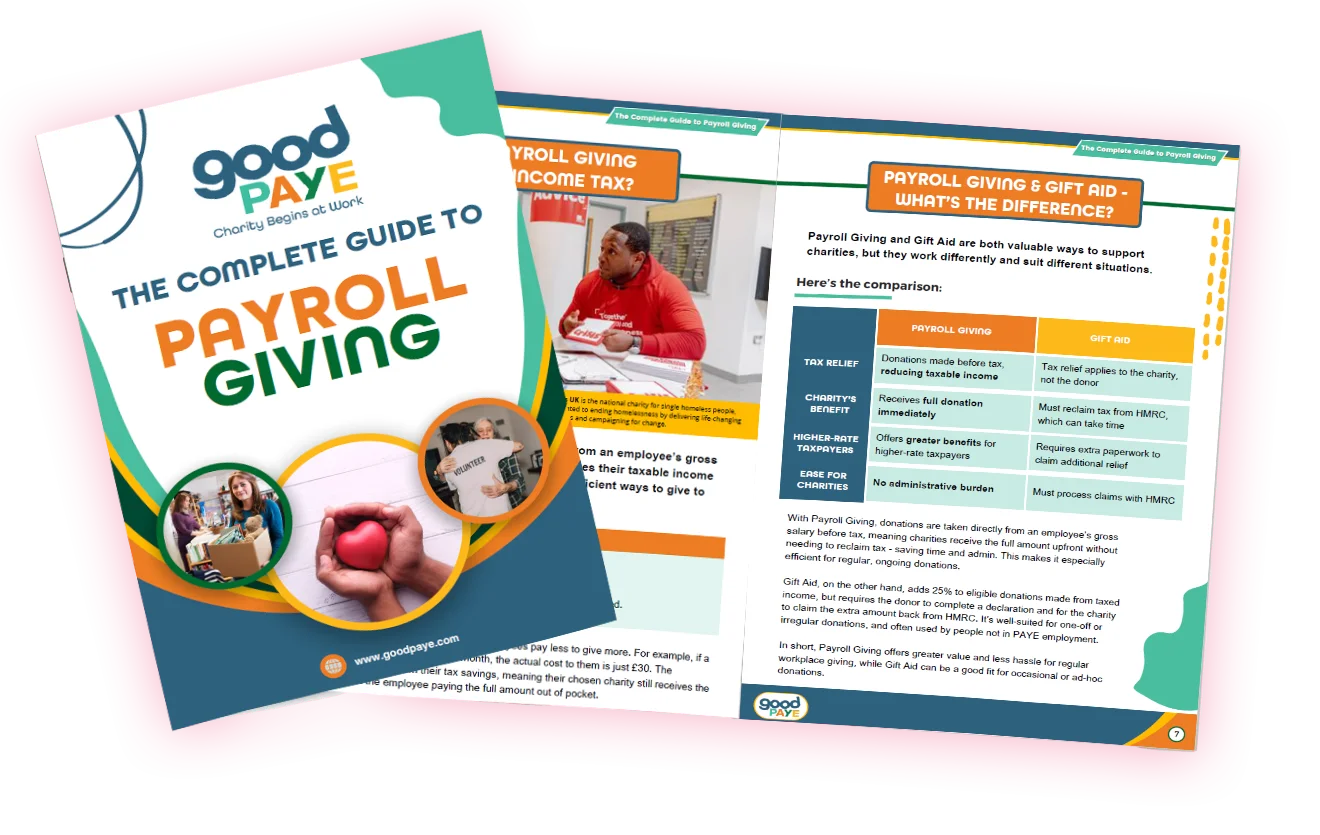
Download your free guide to Payroll Giving here
Everything employers need to know about running a payroll donation scheme.
Gift matching (also known as matching charitable donations) is when an employer agrees to “match” the donations made by their staff. So, if an employee gives £20 to charity, the employer also gives £20. One donation becomes two, and the impact instantly doubles.
Some organisations even go further by offering:
The key principle of company matching charity donations is simple: amplifying generosity.
Charities receive more funding, employees feel empowered and employers demonstrate genuine commitment to their social values.
Top tip: Employers can match every month
Modern payroll giving platforms like ours allow charitable deductions directly from salary (pre-tax), which makes it easy to layer a matching component on top for month-on-month donations. This automates much of the manual work that used to slow down employer matching donations.
Looking for some inspiration? Here are some great examples of how charity matching can operate…

Aviva runs a scheme called £Plus matching for “colleague fundraising” (i.e. when employees raise money), whereby they commit to matching up to £1,000 a year.
Their public sustainability site also confirms that UK colleagues can donate via payroll giving or fundraising and Aviva matches these donations (with limits) to enhance community impact.
The company uses matching to boost both individual and team fundraising efforts.
Why it’s relevant:

Barclays has a scheme under which colleagues can have personal donations or active fundraising matched by the company. The matching is limited to £1,000 per colleague per calendar year.
According to PTA fundraising guidance, Barclays is often cited as offering to match funds raised by employees’ dependents up to £750 per year, typically allowed in three separate matched giving activities.
Why it’s relevant:

During the COVID-19 pandemic, the UK government launched the Community Match Challenge, pledging £85 million which was matched by private funders. This enabled charities to draw extra resources in a crisis.

In this short webinar, we cover:
The impact Payroll Giving has
How employers can make a difference
What you can do to drive social change
Employees usually access company matching schemes through a process that typically looks something like this:
In some businesses, technology makes this even slicker. Specialist platforms like ours, lets employers launch a branded giving portal, integrate with payroll for pre-tax deductions, track employee donations transparently, and distribute funds to charities. Because we’re charity-owned and B Corp certified, the focus is purely on impact, not profit. That means less admin fuss and more giving — exactly what company matching schemes need to scale.
The result? Staff don’t just donate once; they’re more likely to give again and again because they know their company has their back.

On the surface, matching charitable donations might look like a pure act of goodwill. But there are plenty of tangible business benefits too:
A strong employee donation matching programme proves that an organisation lives its values. Employees feel proud to work somewhere that invests in causes close to their hearts.
Studies have shown that engaged employees are more loyal, more productive and crucially less likely to sneak off at lunchtime to interview elsewhere.
Company matching sends a clear message to customers, investors and communities: this is a business that takes social impact seriously.
Whether you’re chasing ESG goals or working towards the next sustainability award, employers that match donations have taken a visible, measurable step.
It also plays beautifully into the ESG agenda.
Whether you’re aiming for a better sustainability rating, working towards that coveted corporate responsibility award, or simply trying to keep the board happy with progress on social goals, matching charitable donations contributes effortlessly.
Charities can quantify exactly how much more funding arrived thanks to your business, employees feel proud to work somewhere that genuinely backs good causes and investors see that you’re building long-term goodwill.
A glossy brochure is nice, but telling the world, “Our staff raised £100,000 for local charities and we matched every penny,” has far more impact.
It turns lofty statements about community engagement into something authentic and headline-worthy.
When jobseekers size up potential employers, salary and job title aren’t the only things on the table anymore. Increasingly, candidates are looking for workplaces that align with their values.
That’s where employee matching schemes shine. They demonstrate, in a practical way, that your organisation cares about more than just the bottom line.
For younger generations in particular, purpose isn’t a nice-to-have, it’s a dealbreaker.
Surveys consistently show they’re more likely to choose and stay with employers who can prove they’re socially responsible. By offering company matching, you’re not just making a charitable gesture; you’re making a strategic investment in your workforce.
The retention benefits are just as strong.
Employees are far less likely to polish up their CVs if they feel they’re part of something bigger. A well-run employee donation matching program makes people proud to wear the company badge, knowing their employer literally doubles their impact.
Matching donations is a recruitment and retention superpower. It will help you attract candidates who want meaning alongside money and keep existing staff engaged for longer.
And doubling donations is a lot cheaper (and far more cheerful) than doubling salaries!
The ripple effect is immediate.
Charities receive larger, more reliable income streams, allowing them to plan ahead rather than lurch from one funding gap to the next.
For employees, there’s a real buzz in knowing their £20 suddenly became £40. Their generosity has twice the reach, and that sense of impact is deeply motivating.
From the employer’s side, matching builds goodwill not only with staff but also with the communities in which they operate. A matched giving scheme is a tangible way to show you’re not just setting up shop and extracting value, but actually investing in society. Over time, this strengthens community ties, boosts brand reputation and cements your role as a responsible employer.
Everybody genuinely wins.
Charities can expand their services, employees feel valued and empowered, whilst businesses earn the kind of positive PR that money alone can’t buy.

So, how does an organisation actually set up company matching? Here’s a step-by-step approach:

Matching donations is one of those rare win–wins: charities receive more funding, employees feel proud and employers gain a reputational edge.
Whether you’re considering your first daliance into donation matching or fine-tuning your existing company matching efforts, the principle is the same — generosity multiplied (no bake sale required!)