After filling in the form, we'll give you a whistle stop tour of our platform, showing you how easy Payroll Giving is to get set up.

 Payroll Giving Explained: Everything employers need to know >>
Alice Wright, GoodPAYE
Not so long ago, doing good at work usually meant a once-a-year charity event, a team photo in matching T-shirts, and then back to business as usual. Profit lived in one corner of the organisation. Purpose popped in occasionally, usually accompanied by a bake sale and a clipboard.
That’s changed.
We now live in the era of the social impact business, where doing good is no longer a side project but core to how some forward-thinking businesses work. Purpose is built into the model, not squeezed into a spare Friday afternoon. And yes, it really is possible to grow revenue, keep shareholders smiling and make a genuine positive difference at the same time.
Download your free guide to Payroll Giving here
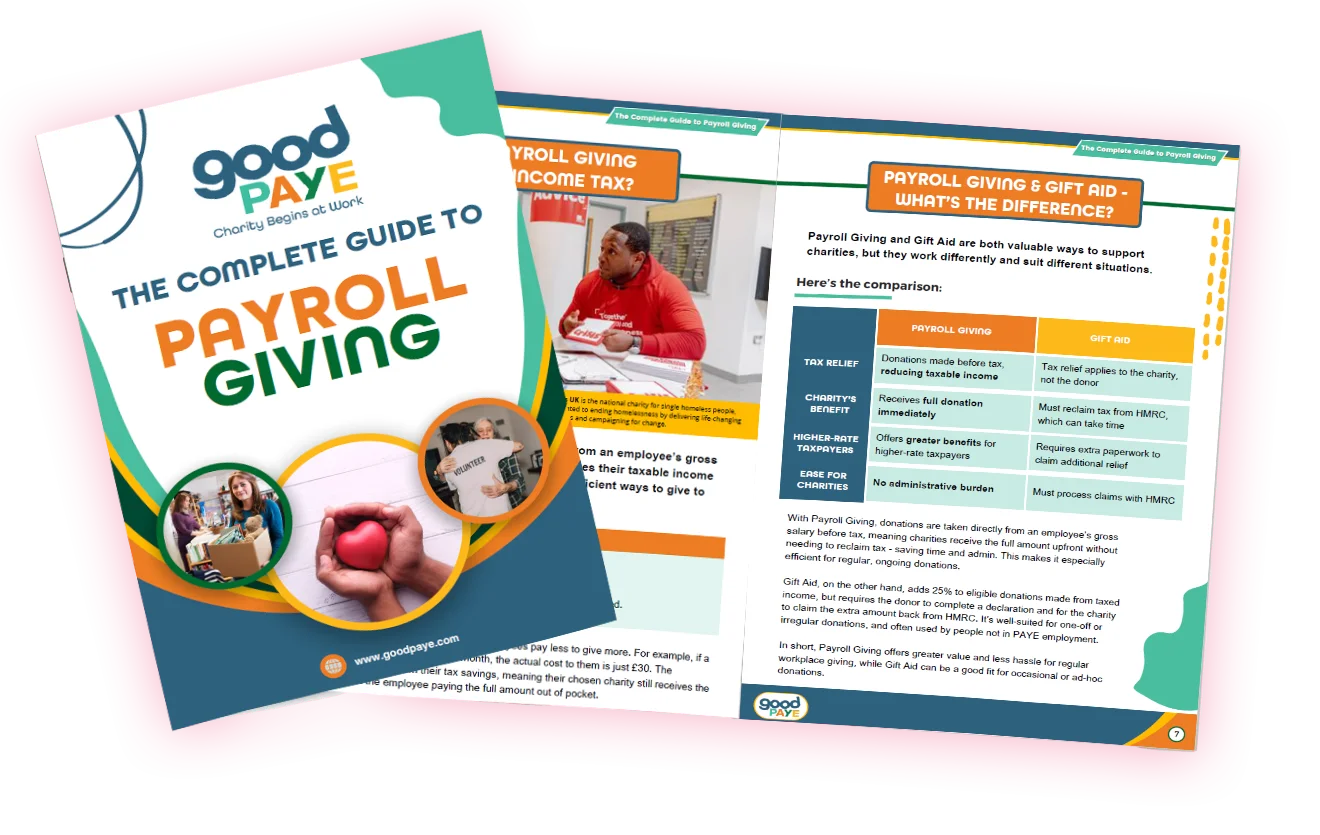
Everything employers need to know about running a payroll donation scheme.
A social impact business is an organisation that aims to create positive, measurable social or environmental change while generating revenue.
The key difference from traditional corporate responsibility here is intent.
Instead of bolting a few good causes onto the side of a commercial strategy, a social impact business builds its mission directly into how it operates – how it works, how it makes money and what it does with its profits. Impact is not something to mention briefly in the annual report and quietly forget. It is the reason the business exists.
Many organisations donate to charity or run CSR initiatives, and that absolutely has value. But social impact businesses simply go further. Their core products and services are designed to address real-world challenges and profits are largely reinvested to expand that impact over time.
So money is not the end goal. It is the engine. Profit fuels purpose (not the other way around).
So what separates a social impact business from a company that simply means well?
It comes down to where purpose lives.
In social impact businesses, purpose is built into the foundations, not added as an afterthought. These characteristics show how values turn into day-to-day action – making a positive impact part of growth itself.
At the heart of every social impact business is a dual mission: commercial success and meaningful positive change for people or the planet.
This blended value model treats financial performance and impact as equally important, not competing priorities.
Rather than delivering impact once profit targets are met, social impact businesses design growth and impact to move together. The more successful the business becomes, the greater its ability to deliver positive outcomes. So revenue does not just follow impact, it helps power it.
This approach shapes strategic decisions across the organisation. Products, partnerships, supply chains and pricing are assessed through both a commercial and impact lens. If a decision boosts short-term profit but undermines long-term social value, it rarely makes the cut.
For corporations, a dual mission creates alignment. Teams understand why the organisation exists beyond profit alone, which strengthens engagement, trust and pride in their workplace. In a world where customers, employees and investors expect more than financial returns, a clearly defined dual mission is fast becoming a strategic advantage for hiring staff and acquiring customers.
A social impact business is not powered by bake sales or crossed fingers waiting for a grant renewal. Instead, it generates income the same way any strong business does: by selling products or services people genuinely want and are willing to pay for.
This earned income model makes impact scalable and sustainable.
Revenue is predictable and directly linked to demand, meaning impact can grow without relying on external funding cycles. When the business grows, the impact grows with it.
Trading income also brings commercial discipline. Social impact businesses must stay competitive and customer-focused. If the product fails to deliver value, the mission does not get funded.
It;s a refreshingly honest feedback loop!
This removes the awkward divide between “the business” and “the good stuff”. Impact is no longer dependent on annual budgets or leftover profit. It is built into everyday operations, which is far more reassuring than hoping goodwill alone will carry the load.
An asset lock is the legal equivalent of tying the mission to the mast.
It ensures that profits and assets are used to further the organisation’s social purpose, rather than quietly drifting towards excessive dividends or a sudden change of priorities. In practice, this means a significant portion of profits must be reinvested into the mission.
This protects against mission drift (that slow slide where impact gradually drops down the agenda as commercial pressures rise). With an asset lock in place, purpose is non-negotiable. It’s written into the rules.
For stakeholders, this creates clarity and confidence.
Employees know the organisation is serious about its values. Customers and partners can trust that impact is not a temporary phase. Even investors benefit, because expectations are clear from the outset.
And while it may sound restrictive, an asset lock actually provides freedom of a different kind: freedom to focus on long-term impact without worrying that success will dilute purpose.
A stakeholder-focused approach recognises that businesses do not operate in a vacuum.
Every decision has ripple effects – on employees, customers, suppliers, communities and the environment – not just on the balance sheet.
Social impact businesses take this wider view seriously. Strategy and decision-making are shaped by the needs and experiences of the people the organisation touches. Profit still matters, but it is not the only voice in the room.
This approach tends to deliver stronger long-term outcomes.
Employees are more engaged when they feel valued. Customers are more loyal when they trust a company’s intentions. Suppliers become partners rather than cost lines. Communities benefit from more responsible practices. And the environment, which rarely gets a vote, is finally considered.
There is also a practical benefit: fewer nasty surprises.
When stakeholder impact is considered upfront, organisations are far less likely to face reputational damage, disengaged teams or backlash later on. A wider lens, yes – but with a much sharper conscience.
Download your free guide to Payroll Giving here
Everything employers need to know about running a payroll donation scheme.
Treating impact as optional now looks a bit like ignoring the internet in the early 2000s – whilst technically possible, it’s not a great long-term strategy.
Strong company social impact strategies support sustainable performance by:
Employees want to work for organisations that stand for something.
Customers want to buy from brands that reflect their values.
Investors want steady growth, not reputational fire drills.
So corporate social impact is now closely tied to competitiveness. Companies that take it seriously build trust, resulting in long-term value. Those that do not often end up paying for it later with interest.

In this short webinar, we cover:
The impact Payroll Giving has
How employers can make a difference
What you can do to drive social change
Measuring social impact is where good intentions grow up and get a spreadsheet. It’s where ambition meets accountability, and where organisations move from saying the right things to proving they actually work.
Effective corporate social impact measurement focuses on outcomes, not just activity. It asks one simple question: what has genuinely changed because our organisation exists?
Here’s how companies approach it…
Be clear about the social or environmental issues you want to address and how they connect to your business strategy. Vague ambitions are difficult to measure and even harder to manage.
Avoid vanity metrics. Focus on indicators that show real change, such as improved wellbeing, reduced emissions, increased access to services. If it doesn’t tell you whether life got better, it probably isn’t the right metric.
Outputs show effort. Outcomes show impact. Both matter, but outcomes are where the real value lies.
Impact measurement works best when you use a mix of quantitative data and qualitative insight (impact is human, after all).
Honest reporting builds trust. Sharing challenges and lessons learned is far more credible than claiming perfection.
Download your free guide to Payroll Giving here
Everything employers need to know about running a payroll donation scheme.
Some of the strongest social impact examples come from organisations that embed purpose into everyday operations, not just marketing campaigns, such as:
Fair pay and wellbeing
The John Lewis Partnership has long championed shared ownership, profit participation, and employee voice. They place fairness and wellbeing at the centre of how the business runs.
Skills-based community support
NatWest Group focuses on enterprise and financial education, helping individuals and small businesses build long-term resilience rather than relying on short-term funding.
Product-led environmental impact
Unilever embeds sustainability into product design, from reducing plastic use to responsible sourcing, addressing environmental impact at scale.
Making giving easy for employees
Aviva enables payroll giving with matched funding, turning good intentions into consistent action by removing friction.
The common thread across these company social impact examples is consistency. Impact is treated as a business discipline that’s planned, measured and improved over time.

10 ways to improve the social impact of your organisation
- Embed social impact into your business strategy
- Align impact goals with core products or services
- Involve employees in shaping impact initiatives
- Choose suppliers with strong ethical standards
- Support payroll giving or purpose-led benefits
- Measure and report progress consistently
- Set realistic, time-bound impact targets
- Partner with credible social organisations
- Tie leadership incentives to impact outcomes
- Review and refine, so your impact evolves as your business does
Being a social impact business is not about choosing between profit and purpose. It is about recognising that long-term success depends on both working together.
For corporates, social impact has moved well beyond being a “nice story for the website”. It is a strategic lever that influences talent, brand trust and company relevance in an increasingly conscious world.
If your business can perform well financially and make a positive difference at the same time? That’s not idealism, it’s sound business sense that frankly, has been a long time coming.