
After filling in the form, we'll give you a whistle stop tour of our platform, showing you how easy Payroll Giving is to get set up.

 Payroll Giving Explained: Everything employers need to know >>

Alice Wright, GoodPAYE
If you work in HR, you’ve probably sat through a meeting where CSR, ESG, social impact and sustainability all got mentioned within the same five minutes. Sometimes by the same person, sometimes interchangeably. They’re closely related, but they’re not the same thing, and mixing them up can make responsible business sound far more complicated than it needs to be.
Here’s the plain-English explainer, to help you get your head round the differences.
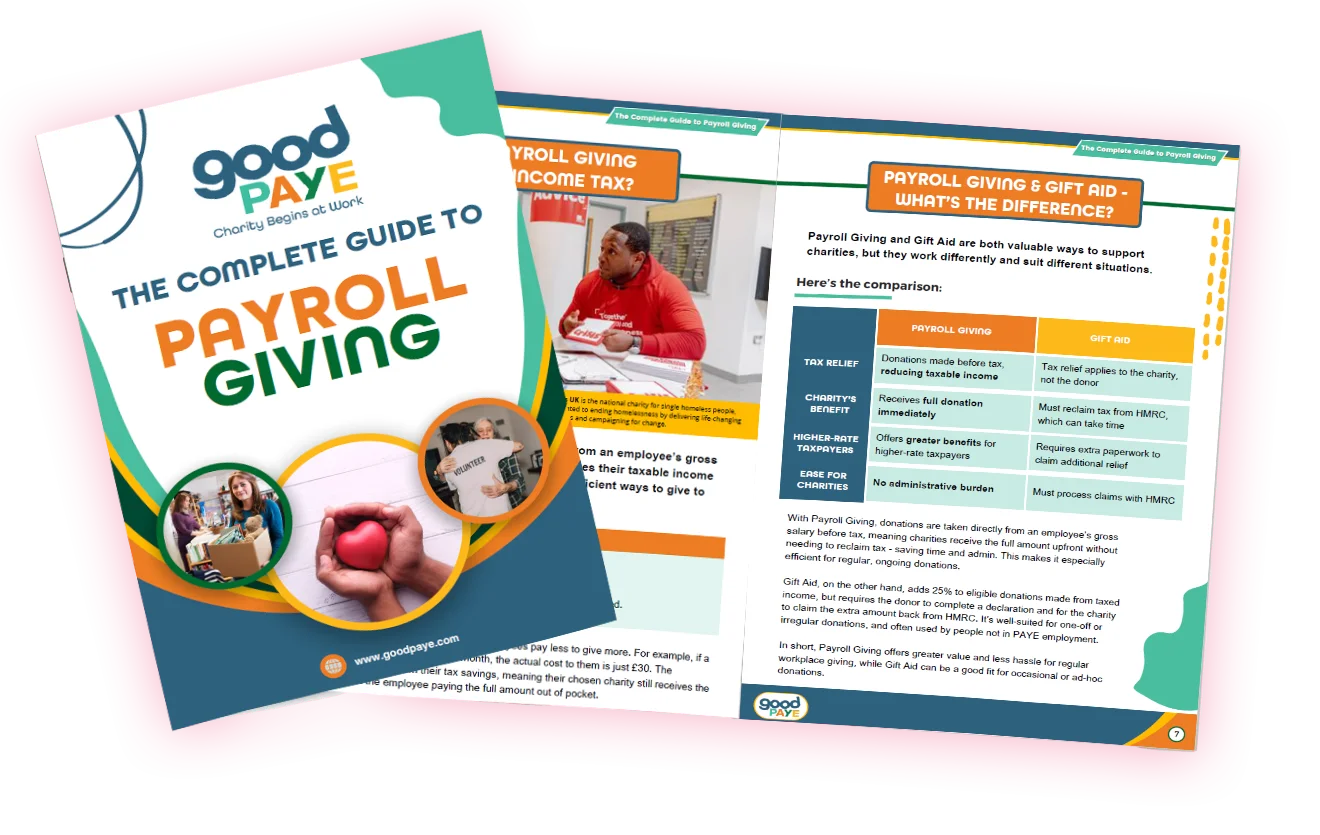
Download your free guide to Payroll Giving here
Everything employers need to know about running a payroll donation scheme.
CSR stands for Corporate Social Responsibility. It’s about how a business takes responsibility for the impact it has on people, communities and the planet and what it does about it.
That might look like:
CSR is usually where a company’s values turn into practical action. A few paid volunteering days here, a local charity partnership there, maybe a Payroll Giving scheme so staff can donate straight from their salary. It tends to be broad, flexible and, above all, people-focused.
Want the full picture? We’ve written more on how CSR and charity work together.
ESG stands for Environmental, Social and Governance. Where CSR is about action, ESG is a framework for measuring how responsibly a business actually operates, and it’s built around three pillars:
The CIPD’s factsheet on corporate responsibility puts it well: ESG tends to be shaped by how investors view a company, whereas CSR is closer to the ground in the everyday actions a business takes. For more on the people side specifically, we’ve gone deeper on ESG and social impact and why the ‘S’ matters as much as the other two letters.

The simplest way to think about it:
CSR is what a business does to act responsibly. ESG is how that responsibility gets measured.
CSR is about action and impact. ESG is about performance, accountability and reporting.
Take a company that runs a CSR programme encouraging staff to volunteer with local charities. Under ESG, that same activity feeds into the organisation’s Social score, providing evidence of community engagement and employee participation. It’s essentially the same activity, but looked at through a different lens.
They’re not rivals. If anything, they need each other. CSR gives a business a way to put its values into practice; ESG gives it a structure for measuring, understanding and reporting on the difference those actions make.
| CRS | ESG | |
| Stands for | Corporate Social Responsibility | Environmental, Social and Governance |
| Focus | Responsible business activity | A framework for assessing performance |
| Centred on | Actions and initiatives | Measurement, accountability, reporting |
| Typically includes | Charity, volunteering, fundraising | Environmental, social and governance performance |
| Audience | Mostly employees and communities | Employees, customers, investors, regulators |
| Driven by | Company values | Business strategy, risk and reporting |

CSR and ESG can sound like boardroom language, but scratch the surface and most of it is about people, which puts HR right in the middle of both.
It’s better to think of CSR as one of the ways a business puts its values into action, and ESG as the broader lens for evaluating that action alongside environmental and governance factors.
Say an employer gives staff paid time off to volunteer with a local charity, that’s the CSR initiative. Under ESG, that same programme can feed into the organisation’s Social performance, evidencing community engagement and staff participation.
The trick is not forcing every CSR activity into an ESG spreadsheet. The activity needs a genuine purpose first; measuring it comes second.

In this short webinar, we cover:
The impact Payroll Giving has
How employers can make a difference
What you can do to drive social change
You’ll hear “social impact” alongside CSR and ESG more and more, and it’s arguably the simplest of the three to get your head round: it’s the real-world effect an organisation has on people and communities. Not the initiative itself, and not the score it feeds into, but the tangible difference that gets made.
It’s easy to blur social impact with CSR because they show up in the same places: volunteering days, charity partnerships, Payroll Giving, etc. The distinction is really about what you’re looking at.
CSR is the programme; social impact is what happened because of it.
A charity partnership is CSR. The extra funding that let a local food bank reach fifty more families this month is the social impact. An inclusive recruitment drive is CSR. The person who got their first job in the sector because of it is the social impact.
It’s easy to measure activity instead of outcomes. Volunteering hours logged, funds raised, events run, those are useful numbers, and worth tracking. But they describe effort, not effect. Twenty employees spending a day painting a community centre is effort. A community centre that can now open on Saturdays because of it is effect.
Knowing the difference helps HR teams have a better answer than “we did X” when someone asks what actually changed.
It’s also where a lot of employees connect emotionally with what their employer does.
A CSR report full of policies and an ESG score full of metrics don’t tend to land with people the way a genuine story does. The local school that got a new reading programme, the charity that could finally hire a second caseworker, the colleague who found real support through the company’s wellbeing scheme during a hard year. Social impact is what gives CSR and ESG their “so what.”
Workplace giving allows employees to support charities and causes they care about directly through their salary.
Donations are made before tax, allowing employees to give more to charity at a lower personal cost.
These programmes provide employers with a straightforward way to support charitable giving while contributing to wider social responsibility goals.
Use CSR to build initiatives employees can get involved in — the volunteering, the fundraising, the Payroll Giving scheme that makes giving back part of working life rather than a once-a-year gesture.
Use ESG to understand the organisation’s wider responsibilities and track whether progress is real.
And keep social impact at the centre of both, so what you end up with is more than a well-written paragraph in the annual report.
None of this was ever really about getting the acronym right. It’s about doing the right things, consistently, and being able to point to the difference they’ve made to a community, to a colleague, to a business that’s better for having tried.
Want to go further? Read our guides on ESG and social impact and how CSR and charity work together.